Investors Judge You Before You Say a Word
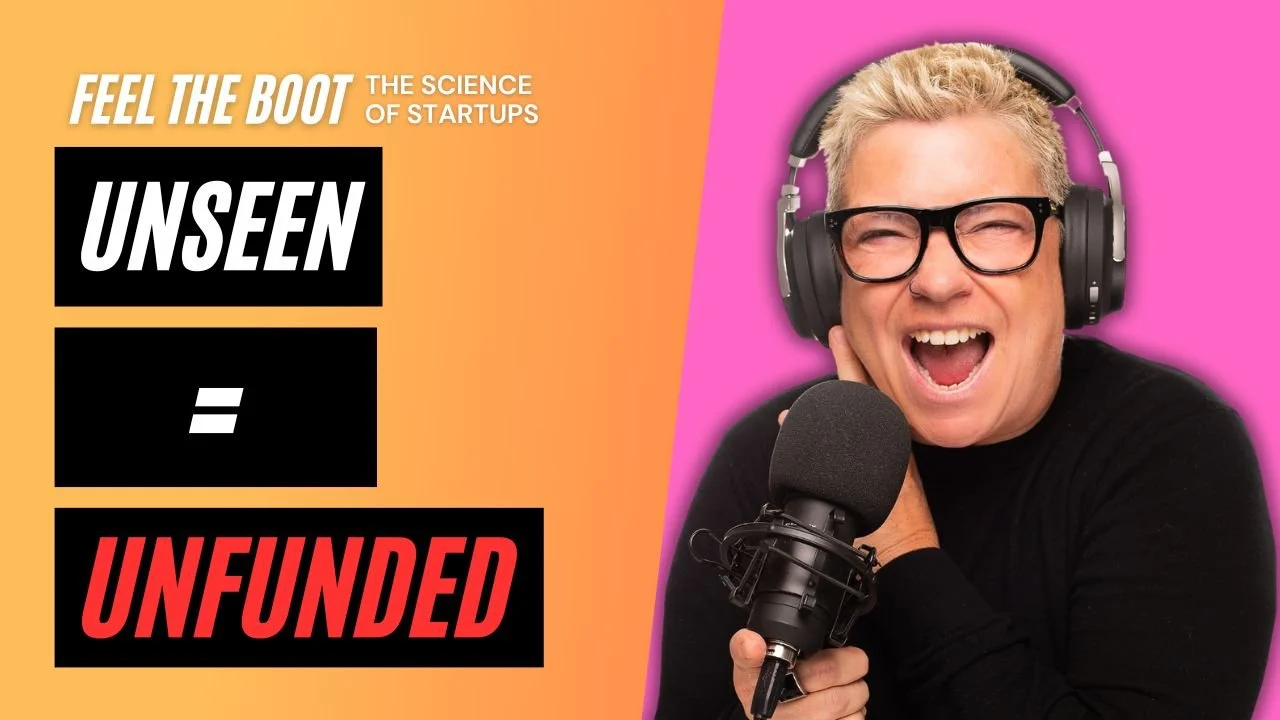
Christine Blosdale interview video
By the time you start your pitch, the investor has already decided a surprising amount about you.
They have read your LinkedIn, run a quick search, and quite possibly asked ChatGPT who you are. They have a sense of your photo, your headline, and the general look of your deck before reading a word of it. None of that is fair, but it is how the process actually works.
At the early stage that first impression matters enormously, because the investment is in the founder far more than the product. I say it on the show all the time: we are betting on the horse. You are going to pivot, and your projections are wrong anyway. So the question sitting underneath every other question is whether I believe you specifically can figure this out.
That is why I brought Christine Blosdale on for episode 133. She is the Expert Authority Coach, and she spends her days on the exact problem most founders ignore: how to be seen, trusted, and taken seriously before you have the traction that would earn it automatically. We aimed the whole conversation at early-stage founders who are raising. A few things stayed with me.
Clarity beats credentials
Christine's first point is one I see violated in nearly every weak pitch deck. Founders get so deep in their own world that they forget what it was like to not understand the thing. So the deck opens somewhere in the middle, leads with credentials, and buries the one sentence that tells me what the company actually does.
Her fix is to say it at a fifth-grade level. Who you are, who you serve, the problem you solve. When I review decks, my version is asking the founder to "tell me the big stupid thing." What is this, in one plain sentence, before any of the clever stuff? If you cannot get there, the problem is clarity, and investors tend to read a lack of clarity as muddled thinking.
The signal you send before you speak
Christine and I both get pitched constantly to appear on our shows. Most of those pitches give me no reason to believe the person will be any good on camera. Hers did. She sent a media kit built around one photo: headphones on, mic in front of her, mid-laugh. Before she said a word, the package told me this was not her first rodeo.
That is the whole game. Your headshot, your profile, the way you carry yourself, all of it signals whether you are a professional who gets things done. Founders fail this constantly. The classic tell is the team slide where every photo is wildly different and not one of them is professional. One person cropped out of a shot at a bar, somebody else squinting at Disneyland, a third in a dim selfie. It reads as a group that did not think this mattered, and I would not hand them twenty bucks, let alone two hundred grand. Get one round of real headshots done. They show up on your LinkedIn, your deck, and your site for years, and it is about the cheapest credibility you can buy.
Confidence without the stink of ego
A lot of founders try to project confidence and land on braggadocio instead, which trips every alarm I have. Christine's framing here was the cleanest I have heard. You can stand on a mountaintop and say "I am very good at what I do" with no arrogance in it at all, as long as you stay honest about what you do not know. "I am very good at this. Am I perfect? No." That reads as confidence. "Don't worry, I will figure all of it out" reads as someone about to lose my money.
She also took on imposter syndrome, which tends to hit the strongest founders hardest. The Dunning-Kruger pattern is real: the people who know the most are often the least certain, while the people who know the least charge ahead. Her reframe is that imposter syndrome is mostly an overachiever's affliction, and that great actors have it worst of all, because playing a character is easy and playing themselves is terrifying. Useful to keep in mind the night before you pitch.
You cannot see your own crown jewels
This was my favorite stretch, because I hit it every week. You are too close to your own story to see what is valuable in it. Christine described digging through a client's background while he listed off worthy little nonprofits, until she finally pried loose that he had once spent six months at Walt Disney. He thought it was not worth mentioning. It was the most investable line in his whole history.
I do the same thing with decks. I ask founders far more follow-up questions than any investor ever would, and over and over I find that the real insight, the thing that makes the company interesting, never made it into the deck. You buried your best asset because you have looked at it too long. Get an outside set of eyes whose only job is to find it.
Where investors actually look
For founders, the front door is LinkedIn. That is where investors go hunting, so that is where the signal needs to live. Christine is bullish on video there, because voice and eyes and energy carry things text cannot, and video is easy to pass around.
Then there is your wider digital footprint, and this is the part founders are sleeping on. It used to be about SEO and what Google returned. Now an investor is also going to drop your name into ChatGPT. If the answer is "no information found," that is an unsettling result for someone about to write you a check. Podcasts, writing, getting published, all of it exists so that something real comes back. And it takes months to build, so the time to start is well before you need it.
One more thing, if you are an outsider
Most of the Feel The Boot audience is not already inside the warm-intro, insider VC circle. If that is you, everything above matters more, not less. Without a partner at a fund vouching for you, your public signal is the first thing an investor finds, and sometimes the only thing. So you do not get to skip this work. The upside is that doing it well lets you leapfrog the founders who assumed their network would carry them.
About Christine Blosdale
Christine offers a free tool for exactly this kind of self-assessment, a ten-question quiz on how you are showing up: expertauthorityquiz.com. You can find more of her work at christineblosdale.com, on LinkedIn, and on Instagram @christineblosdale.