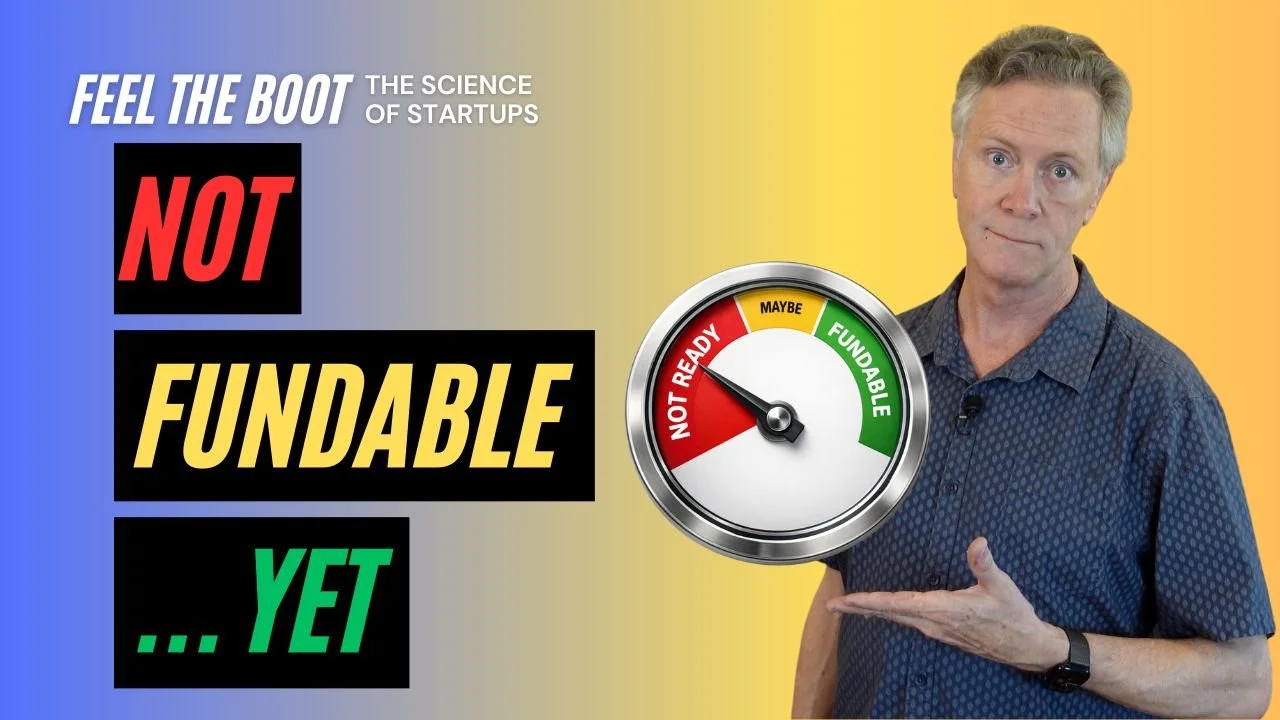
The 4 Filters: Why You Aren’t Fundable... Yet
The Diagnostic Summary (TL;DR)
Fundraising is Physics, Not Art: Pitching is just a signal; the real work is the structural integrity of your business.
The 4 Filters: To be investable for pre-seed fundraising, you must pass four specific stress tests: The Math, The Evidence, The Moat, and The Machine.
Validation Beats Persuasion: If you can’t prove customer hunger or unit economics with data, no amount of "slick" presentation will save a broken model.
Don't Get Caught in "Fundraising Theater"
Many founders think fundraising starts with a pitch deck. It doesn't. By the time you're making slides, the outcome is already 99% decided.
I see founders "play-acting" at pitching—polishing transitions and font sizes while their fundamentals are collapsing. That’s just lipstick on a pig. You cannot pitch your way out of a weak business. Before you start outreach, you need to "pop the hood" and see if you actually have an engine.

Filter 1: The Math (Market, Exit, and Timing)
Venture capital and angel investment are governed by portfolio math, not greed. Investors know 80% of their bets will go to zero. For the math to work, the winners must return 50x to 100x the investment.
The $1B Requirement: If your business can’t realistically reach a $1B valuation—requiring roughly $100M in annual revenue—it isn't venture-investable.
The "Why Now" Delta: A big market is just static mass. You need velocity. What revolution (tech, regulatory, or social) just occurred that makes your solution possible today when it was impossible two years ago?.
The Corpse Audit: If the road is littered with the corpses of companies that tried this before, you need to be a forensic CSI. Why did they die, and why will you survive?.
Filter 2: The Evidence (Proof of Hunger)
CASE STUDY: The "Empty Box" Syndrome
A few months ago, a founder pitched the screening committee at the North Bay Angels. On the surface, it was a masterclass—a 10-out-of-10 presentation that left everyone in the room impressed. But as soon as we 'popped the hood' in the post-pitch discussion, the engine fell apart.
We realized his entire go-to-market strategy was just hand-waving. He had big numbers but no financial model, no CAC (Customer Acquisition Cost) data, and zero evidence from detailed customer interviews. It was beautiful wrapping paper on an empty box.
Because he lacked the Evidence filter, he didn't move forward to the next round. Investors don't buy the paper; they buy what’s inside the box.
To pass this filter, you must prove:
"Drop Everything" Utility: Don't confuse "that’s a nice idea" with "I will drop everything to buy this now".
Unit Economics: Can you reach customers profitably?. If $1 of marketing doesn't generate at least $2 of net profit (eventually), your Machine is broken.
Are you ready? Use my Investment Readiness Scorecard to identify the gaps in your fundamentals before you waste time pitching.
Filter 3: The Moat (Structural Defensibility)
Founders love the "First Mover Advantage" myth. In reality, being first often just means you're the one clearing the land mines for the person behind you.
You need Friction to keep competitors out:
Switching Costs: If a customer can "unplug" your product in five minutes, you have no moat.
Network Effects: Does the value of your product increase as your user base grows?.
The "Crush You" Test: If a well-funded predator decides to roll up with a truckload of money, what—specifically—stops them from crushing you like a bug?.
Filter 4: The Machine (Founder-Market Fit)
Investors don't fund Science Experiments; that’s what grants are for. We fund the scaling of a proven solution.
The Team: Are you the "Dream Team" for this specific strategy?. If your team is just "me and some friends," that’s a mass-to-thrust ratio problem.
Unique Insight: What do you know about this market that everyone else, including the incumbents, is getting wrong?. This insight is the blueprint for your machine.
Fundraising is a Process, Not Luck
If you have these four filters nailed down, building the deck is a piece of cake. If you don’t, you can’t fake it. You might get a meeting, but the deal will die in due diligence.
Stop guessing. Run the experiments. Fix the structural issues. Then, and only then, start pitching.
Next Steps for Your Startup:
Check out my guide on the 6 Pitch Decks Every Founder Needs to ensure your presentation matches your newfound structural integrity.