The Real Odds of Getting Funded, Stage by Stage
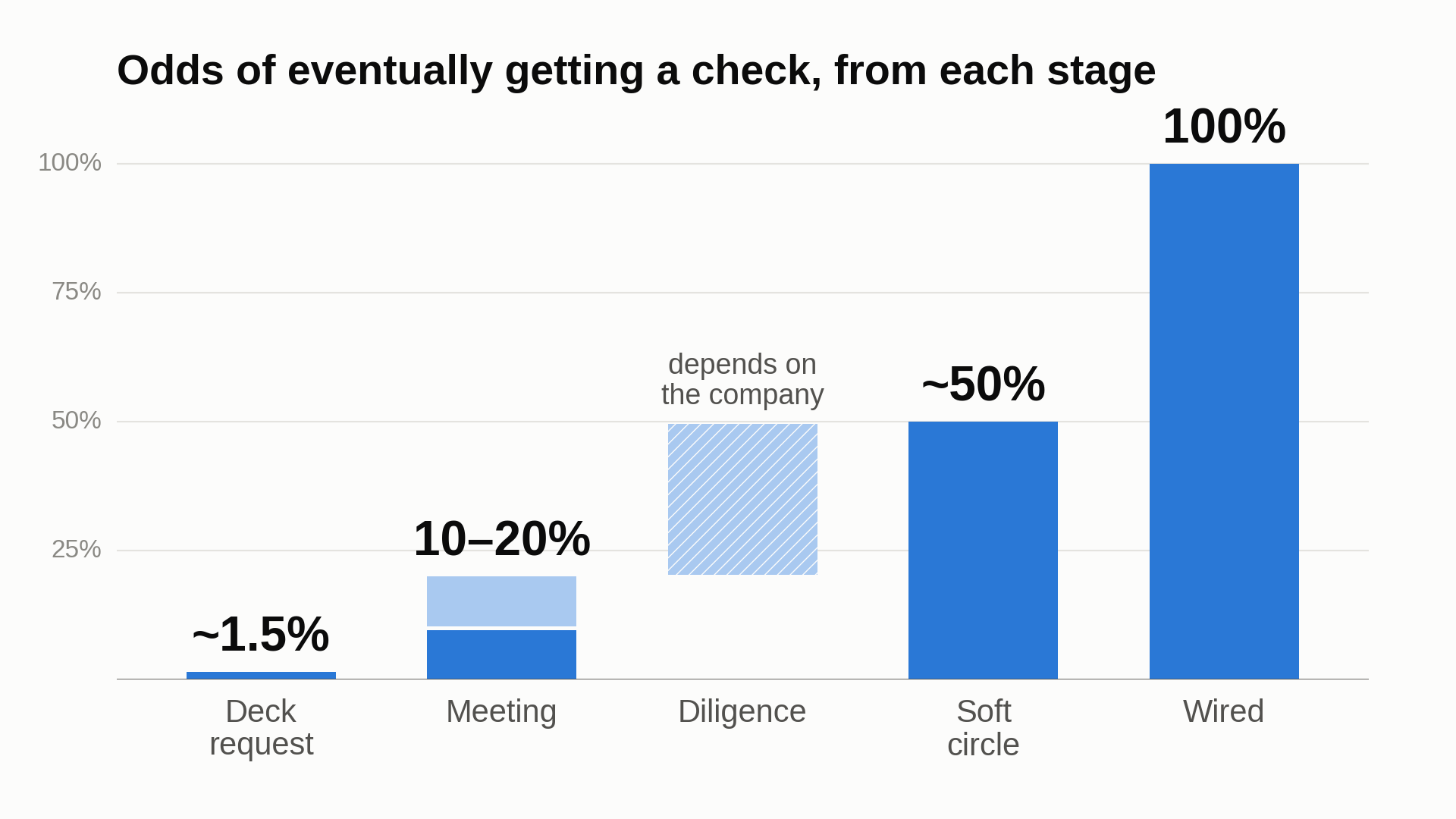
When a founder reaches out to me and I ask them to send the deck, there's on average about a one and a half percent chance that I'll end up writing them a check.
Most founders hear "send me your deck" as a really strong statement of interest.
I'm president of the North Bay Angels, and between the group and my own deal flow I see roughly a thousand pitches a year. In this post I'm going to walk through how the odds change at every stage of the process, from the first request for your deck through final commitment and soft circling. Most investors don't want to talk about how few investments they actually make compared to the number of outreaches they get. It just isn't a good look.
The investor funnel has six steps
You reach out to them. They ask for a deck. You have a conversation. They do due diligence. They commit to the round. And finally, they wire the money.
For me, that works out to about 1,000 outreaches a year. I ask about 10% of those to send me the deck, so that's around 100 decks. Of the decks I get, about 10% look interesting, which means roughly 10 in-depth conversations. From those, I usually write one or two checks.
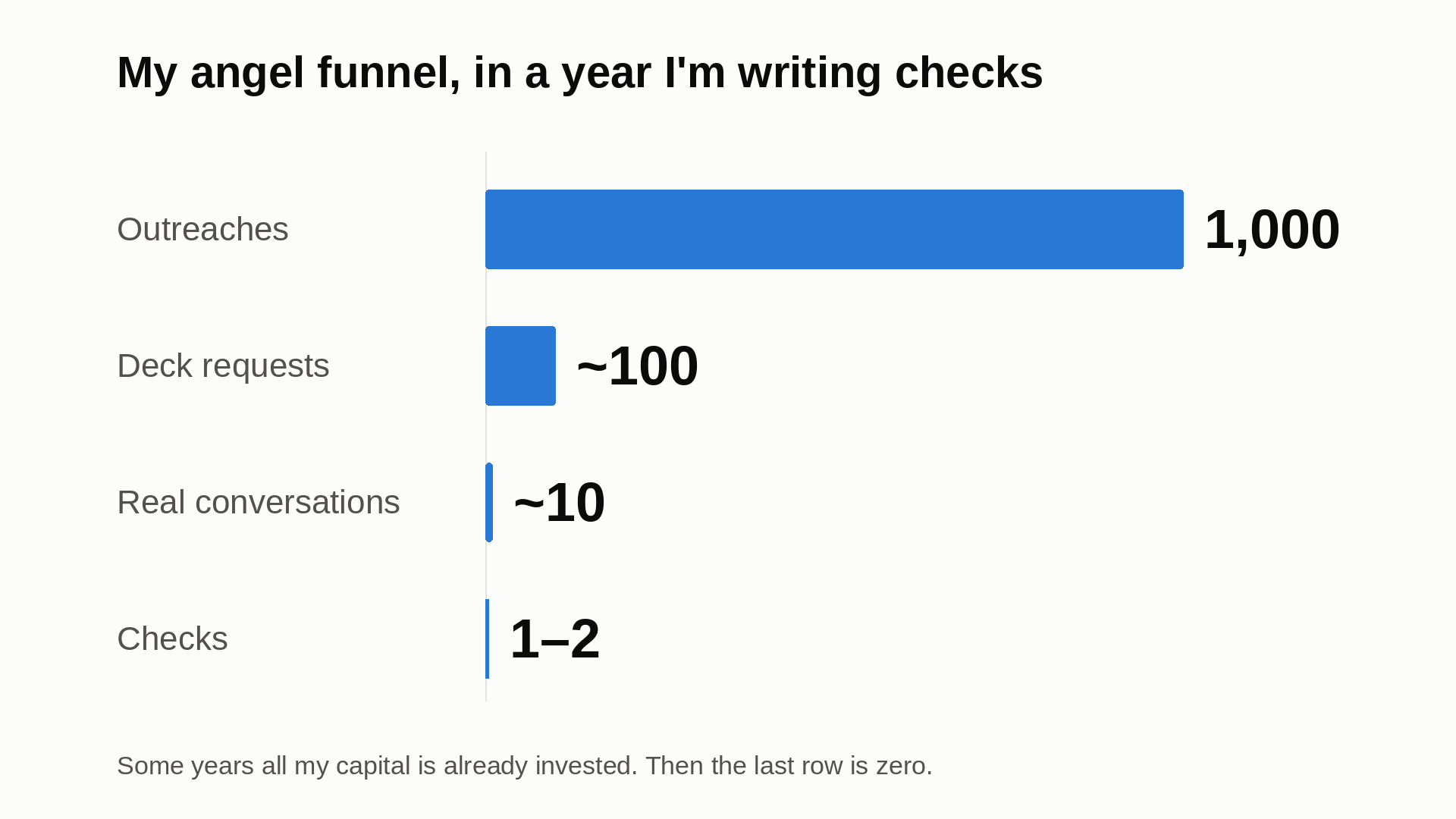
Run that all the way out and a cold outreach has something like a one in five hundred to one in a thousand chance of turning into a check from me.
And to be honest, that's a good year. I'm only writing checks in years when I have capital to deploy. Often all of my capital is already invested in companies and I'm waiting for some kind of exit before I can write new checks. In those years I'm still getting pitched, and I'm still asking for decks, but I'm writing exactly zero checks. Average in the dry years and the real odds are lower than the numbers above.
This is true of all investors. We all go through seasons when we're deploying capital and when we're not, and you really can't tell which from the outside. So you're going to be pitching a lot of people who aren't, in fact, interested in investing at all right now, and nothing in their reply will tell you which ones.
How much did that signal cost them?
The amount of effort an investor puts into responding to you tells you how seriously you should take it.
"Hey, send me your deck" took about ten seconds to type, so it carries extremely little weight. Due diligence is a lot of work for the investor, and they don't take that on unless they're pretty serious. At every stage in this post, ask yourself what that signal cost them to send.
How to read the numbers in this post
Every percentage here is the odds of eventually getting a check, given that you've reached a certain stage. It isn't the odds of making it to the next step. So when I say "send me the deck" is 1.5%, I mean that about 1.5% of the founders I ask for a deck end up with my money. That percentage improves as you move up.
Why my numbers are a floor
My numbers differ a little from most investors', because I'm an advisor and I make videos like this, so I want to see more decks than most. I ask for a deck about 10% of the time. I'd guess most angels ask about a third as often as I do. That means a deck request from me carries less weight than one from most people.
Another complicating factor is that the investors you can reach easily are usually the high volume ones. They're seeing the most pitches and the most decks, so the percentage they invest in tends to be lower than for investors who are very selective about what they'll take in, maybe only accepting decks from people who've come in through warm introductions or other known investors.
What happens after they ask for your deck
Here's what each step involves.
The meeting
Once the investor looks at the deck and thinks it looks interesting, they'll ask for a meeting. Very few investors will take a meeting before looking at the deck.
A lot of advisors say you shouldn't show the deck until you have the meeting. It just means you're not going to get the meetings.
In the meeting you get to pitch live, typically with the same deck you already sent. They get to ask questions and drill down to see if there's real meat on those bones, or whether it's all smoke and mirrors. Nobody writes a check immediately after that first meeting.
Once you've had a real meeting, the odds in my funnel are somewhere around 10 to 20%.
Due diligence
If they're excited by what they see, they'll want to start digging deeper. They'll look through all of your documents, set up follow-up meetings, want to talk to your customers, and look at your technology in detail.
At this point the investor is seriously interested. They're looking for evidence that justifies that interest, or for red flags and landmines that would blow up the deal. They want to find those now, before they've written the check.
I'm not going to put a number on this one. At this stage the odds depend so heavily on the specific company that a general percentage isn't worth much.
The commitment
Then, if the investor is still interested, they commit. "I'm in for $100,000." Or $50,000, or 200, whatever the number may be. They're saying they're in the round. This is what's called a soft circle commitment.
The hard reality is that only about half of the people who tell you they're going to invest end up putting money in your bank account. That's what I've seen advising founders through their raises. I don't have a spreadsheet behind it.
One and a half percent, ten to twenty, fifty. The strongest signal you can get short of money in the bank is a coin flip.
Why commitments fall apart
It usually isn't because the investor is trying to do some kind of rug pull. Speaking as one of those investors, I may learn something new about your company. A lead investor may not materialize. I may deploy the money somewhere else before your round is ready to close, and then I don't have any money left to give you.
Back in the day, I had an angel who had committed to wire me a million dollars within three weeks. He backed out at the last instant because his circumstances changed.
This can happen to anyone at any time. Be prepared for everything to be written in water until the money's cleared.
What that means for your round
When your round is full of soft circles, you're not done raising money. Realistically, you're more like halfway there. If you need $500,000 and you have $500,000 soft circled, plan on getting $250,000.
You want roughly twice your raise soft circled before you're allowed to relax. Even that isn't a guarantee. With only three or four investors in a round the math gets lumpy, and a lead walking away can take the followers with them.
Isn't that a lot of wasted effort?
A lot of people will say so. Why keep talking to investors after the round is filled?
Well, of course, the round isn't actually filled. And it's never a bad situation to be able to oversubscribe. You may be able to bring in more money than you needed. You may be able to bring in the late money at better terms than the early money. When people back out, you can backfill them with someone else. You can even set up a waiting list.
You're in the catbird seat when you're oversubscribed. You're in a lot of trouble when your round comes up short because a lot of people you thought were in the bag aren't.
The question to ask at each stage
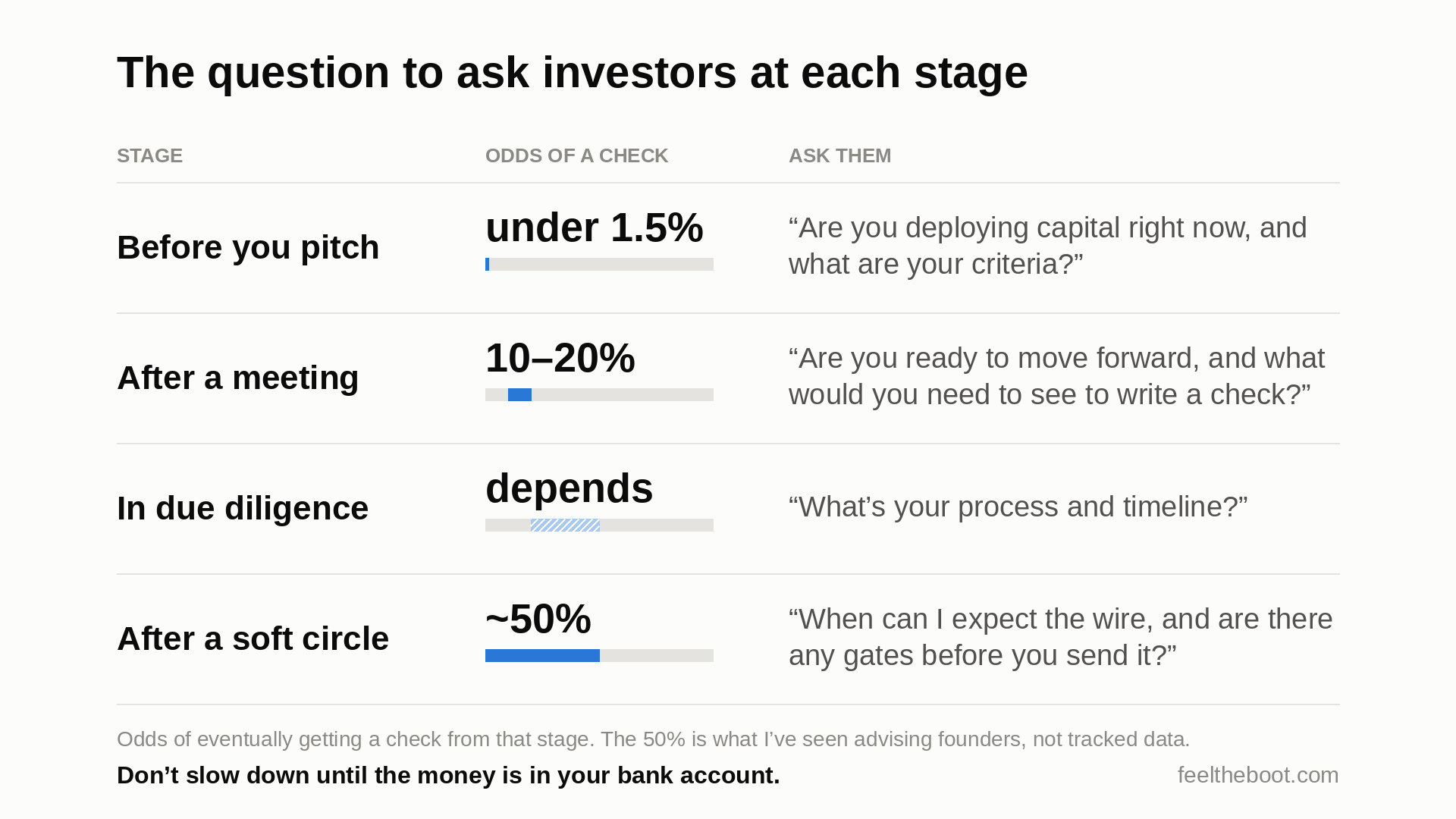
Now let's go back up the ladder, this time with the question to ask at each stage. Each one is aimed at finding out where the investor really is and how serious their interest is.
Before you pitch: "Are you deploying capital right now, and what are your criteria?"
Ask early, often even before you pitch them directly. You want to know whether this person could invest in you, and would, before you put them on your list and start burning cycles trying to convert them. It can feel a little rude, but most investors will just tell you. If they're not ready for a company at your stage, put them in a database, get back to them when you're at that stage, and move on quickly.
After a real conversation: "Are you ready to move forward, and what would you need to see to write a check?"
This tells you whether they're putting you in a waiting pile or you're moving to due diligence. If they can't name anything specific, they're not close. And if you don't meet their criteria yet, you want to know it now, along with exactly what hurdles you need to jump over to get there.
In due diligence: "What's your process and timeline?"
This is where things can slow to a crawl. Investors get distracted with other deals. You really want to hold their feet to the fire. Get a commitment on what they'll do, by when, and what information they need. Make sure your deal room is ready before you start, and when they ask for additional data, get it back to them as soon as possible. Always keep the ball in their court, so they can't blame any delays on you.
After the soft circle: "When can I expect the money to be wired, and are there any gates we need to get through before you send it?"
If you can get a date for the wire, that's much stronger than someone simply saying "I'm going to send the money."
Often what you'll hear is that they won't actually invest until you have a lead investor who will negotiate the terms. This is very common early on. Finding that lead unlocks most of the people who've already expressed interest, so the more quickly you can do that, the more quickly the wires start coming in.
Get it in writing
Far better than a verbal commitment or an email is getting the commitment in writing. Founder Institute put together a document called the PACT. Once an investor has put their name and amount on an agreement, the odds of them coming through at the end of the day improve substantially, even though it's non-binding and you can't force them to write the check.
Match your effort to the odds
Keep in mind where each investor stands, and put in effort based on the odds of that person closing. Don't spend enormous amounts of time chasing someone with a one and a half percent chance of actually writing you a check.
And don't take your foot off the gas until you're well oversubscribed or all the money you need is already in your bank account. Not at soft circle. Not at signed documents. In the account.
If you're getting deck requests and meetings that aren't turning into commitments, or you want to know how your deck reads before your best prospects see it, that's what my Pitch Audit is for. I review your deck and materials ahead of time, then we spend an hour going through exactly what's blocking your raise. You walk away with a written report and a prioritized plan to fix it. $500.
If you've got investors who are seriously interested and you're having a hard time getting them off the fence, this episode on why pre-seed investors delay has several specific techniques for getting them to sign that PACT or wire the money.