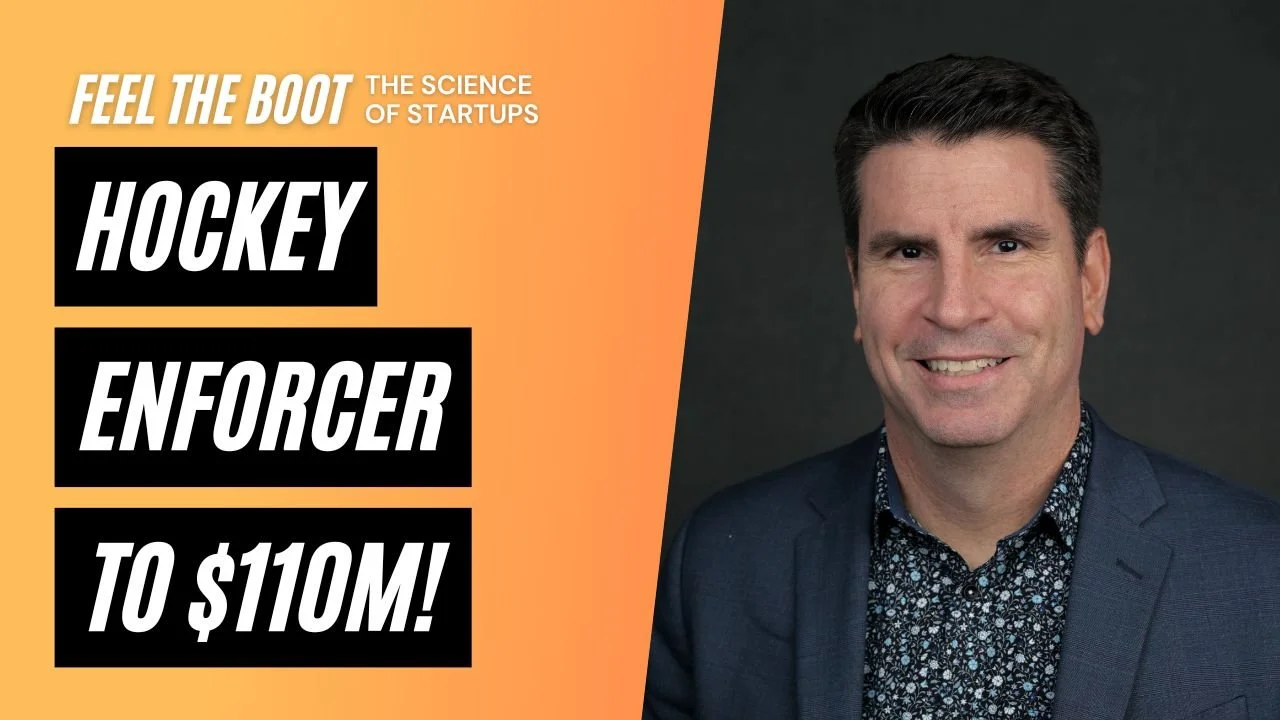
Hockey Enforcer to $110M: Dave Burnett on Grit, Time, and Making AI See Your Startup
TL;DR
Dave Burnett is a serial entrepreneur who helped build Achievers.com (sold for $110M), ran a promotional products business that went to zero twice, during the Great Recession and COVID, and came back both times. A former hockey enforcer and OpenAI beta tester, Dave now runs AOK Marketing, specializing in AI visibility for businesses. In this interview, he breaks down why most companies are invisible to AI models and what to do about it, shares his 1,440-minute time management system built around 10-minute blocks, and makes the case that non-traditional founders have a real edge: the ability to take a punch and keep going is exactly what entrepreneurship demands.
What does a former hockey enforcer know about building companies? More than you'd think.
Dave Burnett's job on the ice was literally to take punches to the face. Not metaphorically. Actual punches. And while he's quick to point out he wouldn't recommend that career path, the parallels to entrepreneurship are hard to ignore. His promotional products business has gone to zero, not once, but twice. He helped build a company that eventually sold for $110 million. He survived a traumatic brain injury that wiped out most of his memory of 2020. And he's still building.
That's what this conversation is really about. Not the highlight reel. It's about getting hit, getting back up, and figuring out what comes next.
The Unconventional Founder's Edge
I've been an angel investor for a long time, and one pattern I keep seeing is that the most interesting founders often come from outside the typical startup mold. The Stanford-grad, textbook-startup-playbook founders tend to be printed from the same mold. They know the theory. They've read the case studies. But when things go sideways (and they always go sideways), it's the founders with scar tissue from other arenas who tend to handle it better.
Dave's a case study in this. His entrepreneurial journey started in the late nineties, before Google existed, doing product sampling in Canadian liquor stores and bars. From there he moved into sales, helped launch Achievers.com (which eventually sold for $110 million in 2015, though Dave had exited back in 2002), started a promotional products company, and then pivoted into digital marketing when the Great Recession killed his promo business overnight.
Here's the part that matters for founders: when his promotional products business went from highly profitable to losing $70,000 a month, Dave didn't curl up in a ball. He went out and bought 3,000 URLs, put up 500 websites, and taught himself SEO. That's not in any playbook. That's someone who's been hit before and knows the only option is to get back up and figure out the next move.
And then COVID did the same thing to his business again. Nobody wants you handing them branded pens when there's a contagious virus going around. Zero revenue. Again. He pivoted to PPE and hand sanitizer, rode it out, and pivoted back when the world reopened.
Dave frames this through Simon Sinek's infinite game concept: business isn't a hockey game with a start, an end, and a clear winner. The objective is just to stay in the game. That reframing matters, because too many founders treat a setback like a final score when it's really just another period.
Your Startup Is Probably Invisible to AI
Here's where the conversation took a turn I think every founder needs to hear.
Dave was a beta tester for OpenAI back in 2017-2018, so he's been watching this space longer than most. His company built a tool called LLMTeL that runs AI visibility reports, essentially checking whether the major AI models know your company exists and whether they recommend you in their answers.
The distinction he draws is important. Large language models have two ways of knowing things: their core training data (which has a cutoff date and takes months to update), and real-time search retrieval (RAG, or retrieval augmented generation). You need to show up in both, and most companies don't show up in either.
Dave's team studied a thousand entities and categorized them into five buckets: completely invisible (the model doesn't know you exist), ignored (it knows you but never mentions you in answers), misaligned (it doesn't know you but you show up in search results), aligned (it knows you and you show up), and trusted (you're known, you show up, and you're actually recommended). Out of that thousand, 319 were ignored and 617 were aligned but not recommended. That's a lot of companies that think they're doing fine but are essentially invisible to the fastest-growing way people find information.
So what separates the visible from the invisible? Dave says it comes down to a few things. First, your online footprint: do you have independent, verifiable third-party coverage? PR, earned media, mentions on high-authority sites like Crunchbase or major publications. Second, your technical SEO: is your website actually structured in a way that machines can understand, or is it all marketing fluff that reads great to humans but means nothing to an AI model? He specifically calls out schema markup (JSON-LD) as a foundational step most companies skip entirely.
For early-stage founders, Dave's advice is practical: build a source of truth (your website) that machines can reference, make sure your information is consistent everywhere it appears online, create content that demonstrates your expertise in your specific domain, and then start generating earned media coverage. It's not glamorous work, but it's the kind of foundational stuff that compounds over time. If you start now, you'll be in a much stronger position when these models update their training data.
1,440 Minutes: A System for Founders Who Can't Find Time
Every founder I work with struggles with time management. It's one of the most common questions I get in coaching sessions: how do I prioritize when everything feels urgent? Dave's system is one of the more rigorous approaches I've encountered.
There are 1,440 minutes in a day. Sleep for seven hours and twenty minutes, and you've got a thousand minutes left. Divide those into 10-minute blocks, and you get 100 blocks. Dave literally maps out his day on a 10x10 grid, one sheet for what's planned, another for what actually happened, then goes back and color-codes the blocks to see where his time really went.
The first time he did this exercise, he discovered he was spending four and a half hours a day on email and only an hour and a half with his family. That's the kind of wake-up call that changes behavior.
But the system isn't just about tracking. It's about constraint-based prioritization. Dave thinks about business in terms of throughput and bottlenecks. At any given time, your business has one primary constraint, usually marketing and awareness for early-stage companies. His argument is that you should be spending the majority of your productive hours attacking that constraint and subordinating everything else until it's resolved. Then you move to the next one.
It's a cycle he describes as acquisition, delivery, and admin. Fix acquisition, and delivery breaks. Fix delivery, and admin breaks. Fix admin, and you need more leads. It never stops, but at least you're always working on the thing that actually matters most.
He also made a point that stuck with me: one extra hour per day, done consistently for a year, equals nine forty-hour work weeks. That's not hustle-porn math. It's just arithmetic. And when you combine that found time with AI tools that multiply your output, the compounding effect is real.
One more thing worth noting: Dave had a traumatic brain injury in late 2018 or 2019 that significantly damaged his brain. He doesn't remember most of 2020. That experience forced him to get even more ruthless about decision fatigue: same breakfast and lunch every day, a wardrobe that all matches, no meetings before 11 AM so his best cognitive hours go to deep work on his primary constraint. When your brain literally can't waste energy on unnecessary decisions, you learn very quickly which ones actually matter.
The Dumbbell Theory and When to Pivot
Dave shared a mental model I think is worth sitting with. He pictures the current business landscape as a dumbbell or barbell. On one end: heavy AI and innovation, where you're competing against the smartest, best-financed people in the world. On the other end: in-real-life, physical, manual services (HVAC, plumbing, events) where you need skilled in-person labor and robots aren't here yet. Everything in the middle is going to get crushed by one end or the other.
That's a strong claim, and I think it's directionally right even if the timeline is debatable. If you're building something in that mushy middle, generic digital services, basic SaaS, anything that's essentially a wrapper around commodity capabilities, you should be thinking hard about which end of that dumbbell you're moving toward.
On pivoting more broadly, Dave draws a useful line. Early on, you have to pivot because you don't know the right answer and nobody else does either. Feedback loops and iteration are everything. But once you've found something that works, even a little, the game changes completely. The same instinct that got you rewarded for trying new things now becomes a liability. You get the itch to chase the next shiny thing instead of doubling down on the thing that's actually working.
As he put it: if that first thing works a little, it probably works a lot. The founders who win aren't the ones who keep starting over. They're the ones who recognize product-market fit when they see it and go all in.
The Bottom Line
Dave's story isn't a rags-to-riches arc. It's a rags-to-riches-to-rags-to-riches-to-rags-to-still-building arc. And that's the point. The grit that came from taking punches on the ice, the discipline that came from mapping every ten minutes of his day, the pattern recognition that came from watching his business collapse twice: that's the stuff that actually builds durable companies.
It's going to suck, as Dave says. For longer than you think it will. And then when you succeed, everyone will say you got lucky. That's just how it works.
Next, you might want to check out this interview with David Homan on why introverts are actually the ideal networkers.
Dave’s Bio
Dave Burnett is a serial entrepreneur based in Toronto with over 25 years of building and scaling businesses. He co-founded Achievers.com (sold for $110M), owns PromotionalProducts.com, and runs AOK Marketing, a digital marketing agency now specializing in AI visibility for businesses. Dave built LLMtel.com, a tool that measures whether AI models like ChatGPT, Claude, and Gemini actually know your company exists and recommend you in their answers. A former hockey enforcer, OpenAI beta tester (2017-2018), Entrepreneurs' Organization member for 19 years, and author of From Bricks to Clicks, Dave brings a perspective shaped by surviving two complete business collapses, a traumatic brain injury, and the kind of persistence that led him to call the same domain owner every six months for 16 years before finally closing the deal. He also co-runs Valleywood Capital and coaches business leaders through Bloom Growth.
Interview Transcript
[00:00:00] Lance: My guest today is a former hockey enforcer. Yeah, that means he was paid to take and give punches to the face. He helped build a company that sold for $110 million, then saw two of his companies go to zero and came back each time. Dave Burnett talks about why founders with a non-traditional background actually have an edge over people running the standard playbook, and how to ensure that AI knows that your company exists.
Dave, welcome to Feel the Boot.
[00:00:32] Dave: Thanks so much for having me, Lance. I really appreciate it.
[00:00:34] Lance: So you've got a very non-traditional background for an entrepreneur, and I think it's a fascinating story. So I'd love to just start off by maybe having you very briefly share a little bit about where you came from and how you've gotten to where you are now.
[00:00:49] Dave: I don't wanna completely date myself, but my entrepreneurial journey starts before Google was invented. So back in the late nineties, and, uh, I, I got started back. In third year university doing, uh, sampling. So if you've ever gone into Costco, people are there giving out free samples of stuff. Well, I'm actually based out of Toronto, Ontario, Canada, and here we have a liquor store and a beer store where you actually is where you buy stuff.
So we were actually doing sampling of booze, liquor, and beer, depending on who our clients were. In the liquor stores, but also in the pubs and bars. So we'd go into a pub or a bar and I would actually go and round the, buy the entire bar, a round of drinks. And so it was, it was a lot of fun. So that's how I got first.
That makes you
[00:01:34] Lance: a popular guy.
[00:01:36] Dave: Yeah. It wasn't my personality. It was definitely the booze. I mean, we're just being real. So it was, it was a lot of fun. Uh, that was at third year university. And then fourth year, and then I sold that off to my partner. And, uh, yeah, the entrepreneurial journey started from there.
I, I started working for somebody else in sales, started a company inside that company called achievers.com that has since sold back in 2015 for $110 million. And so that was great. I, I. Actually exited that business back in 2002. So I can't take any credit for all the growth and everything that they did, uh, on that path.
But then started a promotional products company and then started a digital marketing agency back in oh 7, 0 8 when my promotional products business went to zero. So back in the great recession, for those of you who can remember that, uh, the business went to zero and I went out and bought 3000 URLs and put up 500 websites.
And so got good at SEO. And that's where the digital marketing business started. So promotional products business came back. I know own promotional products.com and ao k marketing.com is the digital marketing. And now we're evolving into SEO for AI because I was also a beta tester for Open AI back 20 17, 20 18, 20 19.
So been in that scene for a little while and combining them together now. So that's, I dunno, that's probably the shortest version possible of the last 25 plus years of my journey.
[00:02:59] Lance: That's fantastic. Well, I think I've actually got you beat. I started my company in 1995,
[00:03:04] Dave: so Oh, you do? You do. I was, yes. I started 97, so absolutely.
[00:03:08] Lance: Just, just edged you out. Um, so I really like founders with non-traditional backgrounds. I think that, uh, the, the Stanford grad tech bro kind of classic Silicon Valley thing, uh, the problem is they're all sort of. Printed from the same mold. And I've, I feel like there's a huge advantage to different backgrounds, different perspectives.
People coming from other industries have insights and understandings of those industries and the problems are facing that you're never gonna just navel gaze your way to. So I, I'd love to understand how your background is factored into your entrepreneurial journey and, and what advantages you think it's given you.
[00:03:52] Dave: Well, my background actually starts a little bit farther back than that. That I think really helps me in my entrepreneurial journey, which is I, I'm an ex hockey player, all right, Canadian, a stereotypical Canadian drink, beer, all that kind of good stuff. I fit, I check all those boxes. But with that side of things, I actually used to be, uh, an enforcer.
On the hockey side of things, and for those of you who don't, aren't that familiar with, uh, hockey, I used to take punches to the face as what I do. So I wouldn't advise that just for clarity. And so after I left hockey, it really was great lessons, just being an athlete in general. Great lessons associated with overcoming adversity.
I, I love the field of boot in turn and there's my Canadian field of boot coming out. Um, but it's, uh, I, I love the name of this because. Adversity overcoming adversity. Adapting to change, and really the process that you do during those times of adversity is really, really important for everybody because we are right now in a serious disruption associated with AI and everything that's happening in the world.
So the question is how do you cope? What do you do? And having certain ways to think through that type of a situation has been very, very helpful for me. So I, I'm, I'm, the company is actually called a OK Marketing and a OK is short for an opportunity knocks and I actually have always been one to do my best to look around the corner, to hear the whispers of what's happening out there and listening to kind of your internal gut instinct saying, Hey, this looks like a thing.
It might really turn into something. So my unconventional background is being willing to smash my face against the wall for long enough until either that opportunity comes up and, or it presents itself. But, but having the framework that, that you really have to kind of endure and believe in yourself and sitting in the basement by yourself at midnight or whatever time of day it is believing in your idea, when those closest to you even are probably saying to you, this isn't a great idea.
This is something, why, why don't you go get a job? Why don't you just go out and, you know, do something that everybody else is doing? And so to have the drive, have the want, have the need to be doing something for yourself is something that I, I've always done. So my process for this is to really analyze things and follow those rabbit holes.
So the first thing is I spend time every day. I'm a real. Stickler when it comes to my time, I actually have, uh, a whole process around that as well. But with innovation, what I try to do is make sure that I'm understanding what's going on and then going down the rabbit holes because something that's happening in the healthcare industry might really be impactful for you in your software development company, which might be impactful for somebody else in their services business.
So understanding what's going on and following my curiosity has been something that's served me well. Over the.
[00:06:51] Lance: I, it sounds a little bit of a Gretzky esque skating to where the puck is gonna be. You're trying to look around the corner, see what's coming down the pipe next.
[00:06:58] Dave: Absolutely. I lo I love that you pulled that, that hockey reference in there.
For sure. It is.
[00:07:03] Lance: It's the only one I know.
[00:07:05] Dave: Well take it. It's a win. That's, that's, it's, uh, it's definitely something where you're trying to build something. So the way I think about it today with ai, and this may be helpful for some of the people who are listening, uh, I'm, I'm thinking about just. Think of a car.
And what I try to do is I'm trying to build a car that has an engine that can be swapped out. So right now with the large language models, things are moving so fast that yesterday's model, two weeks, ago's model, 10 months ago's model is completely outdated. So how do you structure something? How do you build something so you can swap the engine out?
So what I'm trying to do nowadays is build something. That doesn't quite work, but I know when the large language model, whether it's an open AI version or it's a Anthropic version, or a Gemini, whatever, Google, when it gets better, my tool or my solution that I'm building. We'll take off with it. So building one step ahead is one of the hardest things to do.
You're building for the future version of whatever it is that you're using. And so that's, that's really kind of where I'm focusing now. So whatever you're doing, I can only suggest this. Don't build for now. Build for two months from now, six months from now, and then by the time you get there and you get that thing built, you'll be able to swap out the engine that's powering it, and you'll have an amazing product.
So
[00:08:25] Lance: it really is interesting the way that the large, the foundational models have become very interchangeable for most people. Uh, there there's no stickiness at all for, for almost anyone that I've seen. And it's always, who's the cheapest, who's the best, who can achieve this thing right now? Who's, you know, got a, a slight advantage in the specific thing that I'm trying to do.
And other than that, there's no loyalty whatsoever. It'll be an interesting. Race to see evolve.
[00:08:51] Dave: Well, and right now the large language models, if you're using the public models or the available models, uh, out there, they are definitely interchangeable. I have subscriptions to all three. When I say all three, I mean Anthropic and Google and open AI because they all give slightly different answers and they all hallucinate a bit.
So one of the things you can do is put the same question or same query or same. Project you're working on into all three, and then use a fourth one or one of the three at the end and say, okay, compile all these answers together. Give me the best of the best, and then that's your final answer. So utilizing things are so cheap, you can get it done so fast.
That using these models together as thinking partners is actually a great hack today too. And so I, the way my workflow works today is I'll set up models where I literally spend five minutes setting up this model. I'll copy and paste it into another model, into another model, and then I'll go and do the same thing again with whatever next project, with whatever next project.
By the time I've set up five or six things running. The first one has got its answer, so then I go through and evaluate, and I probably spend the next two or three hours evaluating that half hour's worth of work instead of spending six weeks doing the equivalent amount of work. So it's, it's made me and everybody on my team and everybody I work with significantly faster, significantly better at everything that we do.
So if you're not embracing and using it and figuring out how to use it, then you're being left behind.
[00:10:15] Lance: Yeah, I mean, it, it's interesting to see how people are integrating it into their workflows and how it's changing the way, uh, work is done. I've been using this analogy, you're, remember back in the nineties you'd see companies trumpeting, oh, we have a website, we're doing online commerce, or whatever.
[00:10:30] Dave: Yep.
[00:10:30] Lance: And it feels sort of like the same now, if you're jumping up and down and go, Hey, we use ai. It's like, well. Good for you. I mean, that's table stakes now. If, if you're not using AI where appropriate in your business, then you're screwed.
[00:10:43] Dave: Yeah, absolutely. I think in the next few years it's gonna be really rough.
Just so we're clear, I, I think that there's gonna be a lot of efficiencies made a lot of cost savings made a lot of people, unfortunately, let go. A, a lot of, uh, individual roles are gonna be taken over. By agents or individual, you know, prompts basically, or whatever it may be. So there there's gonna be a rough go.
So whatever it is that you're building, I kind of have the thought process that you wanna be on one of two ends of the spectrum. And it kind of looks like a barbell or a dumbbell to me, in my mind, one end of the spectrum is heavy into ai, heavy into innovation. And when you do that, if you select that path, you are going up against the smartest people that are out there that are the best financed.
So if that's where you wanna play, just know that you're stepping into the big leagues with some of these people. The other end of the spectrum is in real life. Physical manual services side of things. You know, if you've got that HVAC or that plumber or that, those types of things where you need real skilled in-person labor and, and robots are coming, but they're not here yet.
But if you need that real in real life situation, events, whatever it may be. That's the other end of the dar uh, the dumbbell or the barbell. It's, it's basically those two things and in the middle with various service offerings and various things, those are just gonna get crushed by one end or the other of that dumbbell.
So that's kind of the way I'm treating it. So you gotta figure out, okay, do I wanna play at the end with the smartest, best, most well financed people? Or do I wanna play at the other end where there's great, smart people, don't get me wrong, but you might have a particular niche or niche that you can work within and build a, build a great business or build a, you know, something that can help those businesses.
[00:12:26] Lance: Yeah, although it's interesting, you can never ignore it. Uh, so right before we started recording, I was mentioning to you that I live up in wine country, so I've got a vineyard. I know a lot of people, uh, in the wine industry, which is a classic low tech business, right? The in, in the actual wine production space, there's virtually no AI involved.
But in the wine marketing and sales and promotion, that is an area where the smart ones are starting to go hard because it is synergistic to what they're doing. Even though they're not AI companies, they can't ignore that piece of the puzzle.
[00:13:02] Dave: Absolutely I, marketing is one of the things that's been tremendously disrupted being in the marketing field.
You know, it's, it's one of those things where even my team members, it was kinda like, okay, a little, little worried about this. I've got a framework that I think about. You got different stages you go through with AI adoption. So you start off with fear. Then you get into skepticism because you tried the AI and it didn't really work out.
You're not sure about all this hype, and then all of a sudden you have a light bulb moment where you're like, oh my goodness, this is actually really good for whatever application and I need to then investigate it. So you go through investigation, then you start to adopt it in your work, and then you start to master it for whatever application you're using it for.
So you've got that fear, skepticism, light bulb. Um, you know, adoption side, side of things. Sorry, investigate, adopt, and then master. And so with those, you, you, you're somewhere on that curve. And I find I continually go back to the light bulb moment because some new technology will come out, some new innovation, you know, songs by using Suno, for example, one of the AI platforms out there, or.
Some of the image generation that's out there, um, SOA and chat, GPT with the video generation, all these different things each have their own, you know, wow moments. And so the question is, what's, what's your wow moment gonna be and how do you actually, uh, adapt to that? And you know, your. Your vineyards are potentially ripe for digitization and disruption as well.
On the AI side of things, 'cause just off the top of my head, I can think of a number of different things that you could do with drones that you could do with, uh, how healthy the plants are. You could, you know, see you could, you could do some kind of, um, tracking associated with, okay, these were the grapes that were then put into this.
Batch of wine that this batch of wine is now certified and is now identified as this batch of wine. And so being able to completely track everything from the vineyard, all the way through to the end user and and tracking that history is potentially something that. Would be valuable to a collector as an example.
So there are ways that you could apply to things, uh, even on a vineyard.
[00:15:15] Lance: Oh, yeah. No, I think there's no question that we're gonna be seeing a lot of that. I've, uh, as an angel investor, I've seen a number of startups in the, in the local area looking at, you know, applying technologies to monitoring for health or pest infestations or water usage or all of those things that, that go with farming.
Yeah. And I think that we will end up seeing a lot of, of intelligence going into farming. Now you touched on marketing a little bit, and I think AI is doing some interesting things to, to that where we used to be really focused on SEO and do you have the right keywords and do you have that? But that seems to be a shifting space.
So what's, what's your take on that?
[00:15:53] Dave: A hundred percent. And so we are actually adapting people's. Perception to try and understand the way large language models work. So we've actually built a tool called Lim Tel, uh, lll, MTE l.com. And, and what we do there is we do AI visibility reports where you actually say, okay, do these models know who you are?
Not only do they know who you are, but do they recognize you? And then do they recommend you in their answers? So if somebody was asking, say for example, who are the best, you know, where's the best wine grown? And then you can get a little farther down the marketing funnel and be like, okay, who is the best wine producer in Northern California?
And then even further down, okay, uh, what's, where's the best Pinot Grigio? I don't know what you grow, but just, you know, throw it out there and um, you know, that kind of thing. And then all of a sudden you could be branded searches as well. So to be found in the large language models, there's an important distinction.
The first thing is the models are actually trained by, you know, going out, crawling the internet, coming back, and then getting that information put into their database, into their neural net. And then what happens is there's a cutoff date, and that cutoff date is when the training stops. So they only have so much.
Information in their mind, and I kind of think of it like a high school grad. You only have so much science, so much math, so much history. You, they kind of get, then you get cut off. But the difference is then the large language model companies, open ais, et cetera, they then spend months training these models to behave well and answer nicely to humans.
And then they get released to the public. So open AI's version 5.0 for example, was trained up until October of 2024 and then wasn't released until August of 2025. So almost 10 months later. And so that was them teaching it to be nice. So that, but that's how they work with their core knowledge. Then the second part of this is anything associated with search also is potentially they have to go out and search.
So the models, you know, that model, for example five was, it was actually. Cut off before Donald Trump was elected. So it knows nothing about Donald Trump's election win. It knows nothing about his presidency. The second one, it knows nothing about any of that. So in order to find out information, it has to go to the internet search, come back, and then tell you that information in its own words.
That's called retrieval, augmented generation. It retrieves. It augments, and then it generates a response for you. So when people are talking about SEO for AI or GEO, which is generative engine optimization, they don't understand that distinction usually, and but they wanna show up either way. So the question is, do you show up in the model's core knowledge?
If it goes out to the internet and searches, can it find you? So we have actually run studies, uh, where people actually fall into a coup. I know like five different buckets there. There's completely invisible. The machine doesn't know who they are and they don't show up in any answers. There's what we call ignored, which means the model knows who they are, but they don't show up in any answers if you're asked about it.
Then there's misaligned where the model doesn't, says that it doesn't know who it is in the core knowledge, but you show up in answers in the AI search. So that's misaligned. And then there's aligned where you, the, the models know who you are in their core knowledge and also you show up in search. And then there's trusted.
So trusted is kind of the peak where you, they know who you are, you show up in the answers, and you're recommended you're in the top one or two, or you're recommended. So that's the way we, we think about it and we did a study of a thousand different. Entities and those entities basically fell into two different buckets.
Most of them were ignored. 319 of the thousand were ignored, and then 617 of the remaining were actually, uh, aligned, but they weren't necessarily recommended. So that's, that's how we did this. So we've done some math associated with it to understand where people fall.
[00:19:47] Lance: So do you see some patterns? What, what characterizes the ones that are getting ignored versus the ones that are aligned?
[00:19:53] Dave: Yeah, absolutely. So the, some of the patterns are what is their online footprint. This is the main thing. Like do they have a lot of independent. Verifiable third party resources, like, you know, what you would normally get with PR or otherwise known as Earned Media. So think about, you know, publications like Crunchbase or publications like New York Times and those types of things.
High crawl news-based websites. Are you getting any coverage on there? And so I always think of that as, are you doing anything cool? Is anybody talking about it, including you, the cool stuff that you're doing. If you are, then you're often shown up in the malls or the models show you and know who you are.
So that's kind of not being ignored. But then to actually be cited in the answers to, to show up and be aligned, it comes down to your technical SEO. How well is your website built? So I think of it like entity authority. How is your entity authority? How authoritative is your entity for that particular subject matter?
So that's how you can kind of fix that, is talk about the cool stuff you're doing. That's basically it.
[00:21:00] Lance: So how would someone use your L one tell. Tool if they wanna understand where they're, where they stand in this.
[00:21:07] Dave: Yeah, it's just basically an AI visibility tool and it shows 17 different models and those models give answers.
Like if you asked it, you know, where's the best wine in the US Maid? It would give all the different answers. And our tool actually shows who shows up for the answer. And then it shows who those competitors are. And then it also shows the individual answers from each of the large language models. So deep seek, Claude.
Chat, GPT, the different variations, Gemini, perplexity, uh, all of those different models and lama and, and all the other ones it are, are all there. So you can see it, you can see what the answer is. You can see if it's, you know, not what you want it to be, and then you can do your best to go out and put the right kind of information out there in the world.
Because in an a EO, like. Uh, that's, uh, ai, AI engine optimization, whatever, whatever acronym you want to use, G-E-O-A-E-O. Um, you need to have consistent information that's truth, uh, like true and trustworthy. 'cause everybody's trying to trick the models. Everybody's trying to fool Google and just rank and do those kinds of things.
But if you have. Independent reviews that say you're awesome at your thing. If you have independent, verifiable sources that are talking about you, that's how the models can say, oh, this is a legit company that really exists, that is at this address, and this address is shown the same across all the, you know, all the listings.
Not only that, there's some Reddit threads and they post on LinkedIn and they actually have really good Facebook page. And they're on X and like all those social things and all the different places. Plus their website is really good from a technical perspective. And they have what's called a knowledge graph, which is interrelated facts about them.
So yeah, a lot of these things all work together to show that this is a real thing. This is a real company, real entity. And to get ranked, you need to have that authority. So I, hopefully that's helpful, but
[00:23:01] Lance: yeah. No, that's great. So if someone's just starting out, you've got a brand new founder, they're just looking to launch, uh, what should they be thinking about doing to make sure that in.
Two years, they're gonna be in that system properly. 'cause I guess in that first six months, the only choice is to be in that retrieval.
[00:23:20] Dave: Exactly. Yeah. Search is the only way that they're the only place that they're gonna be at the beginning. So what they need to do is you need to have a source of truth that you own.
That's the easiest way to think about that is your website. You need to have a website that is a source of truth that the models can all reference, that your LinkedIn page can reference, that your X profile can reference. So you need this source of truth and you need it to be in a format that the machines can understand because lots of people build marketing pretty websites that are lots of marketing fluff, and the machines are like, I don't get it.
I don't know what all those big words mean. So you need to set up something called schema markup, which is, uh, A-J-S-O-N LD file to get completely technical. And what that basically is, is machine language that tells the machines what your site is about and how it relates to other things. So you need to have a source of truth.
You need to have that marketing website for people. Then you need to put in schema markup that will actually help the machines understand what your, your website, and your entity is about. And those are the first foundational steps. Then you need to go and make sure your, like the machines can crawl your website, a bunch of technical things like that.
Build your content because. People need to understand if you, if you do, um, you know, if you are working in vineyards and you want to talk about the different types of grapes, the machine needs to have that information on your site so it knows that you know about grapes. And so you need to have the content and then you need to actually build that out and build that foundation.
And once you build that foundation, you start doing cool stuff that journalists might wanna talk about. Maybe you've got an innovative program, maybe you've got an innovative solution. Maybe you've got something that's a little bit different than others are doing. And getting those journalists PR to talk about you is the next step.
Once you have all that done, and that's basically you're doing GEO, you're getting found on the machines because they will love all of those things together.
[00:25:18] Lance: And it sounds like a lot of those are. Similar that the GEO and the SEO are in fact similar activities in many cases, but there's some, some other.
Specific things for the, for the GEO?
[00:25:31] Dave: Yes, uh, for sure. SEO and I I, I, I just want to differentiate. SEO traditionally is all about technical. Your website, the content on your website, and then back links, so other websites linking to your site. For GEO, you also have a particular, you need to have a particular style.
Of your content, how you have it. So it's easy for the machines to read and regurgitate. You need to have the directories all the same. You need to have a knowledge graph built. You want to have pr, and ideally if you can, you even want to have a Wikipedia page because those are really used heavily in training.
But you gotta be careful with Wikipedia because that is an ecosystem of people who wanna make sure that everything on Wikipedia is notable enough to be on Wikipedia. So it's its own, it's its own animal, but those are the main components that you need.
[00:26:16] Lance: That's right. Well, and, and I know that that misinformation can, can slip in.
For many years I had a Wikipedia page on myself, and at one point, suddenly I had a son named Alan
[00:26:27] Dave: that I
[00:26:27] Lance: unaware of,
[00:26:29] Dave: have a son named Alan. Interesting.
[00:26:32] Lance: And, uh, yeah, no, I have no kids. And so that was, that was a big surprise to me and my wife. And eventually I was able to convince the editors to, to take that back down.
But it's funny, the way things can, can, uh, sneak in.
[00:26:43] Dave: Absolutely they, and it's one of the joys of a open format that, that it has, right. So
[00:26:48] Lance: quick break to the conversation. If you are planning to raise or actively raising capital for your startup, I've created an entire toolkit of resources that you can get for free.
It's some of the resources that I provide directly to the people that I'm coaching. You can get it at the link in the description up
[00:27:05] Dave: there, or feel the boot.com/raise. Now back to Dave.
[00:27:09] Lance: Early on you talked about time management. And this is something that when I'm working with founders, I'm amazed how often they're asking me about how to prioritize tasks, manage things, you know, organize their time because it is an inherently insane business.
Starting a company, you're pulled in a million directions, right? It's, it's basically an impossible thing to try to do. You know, you've gotta learn everything all at once about everything. And so I'm always curious to hear other people's, uh, answers to that, how, how they approach this problem.
[00:27:41] Dave: So I, I get pretty mathematical, so apologies to anybody who's not into this, but I divide a day up into its minutes.
So there's 1,440 minutes in a day. If you sleep for seven hours and 20 minutes, that leaves a thousand minutes left in a day. If you take those thousand minutes and divide them into 10 minute blocks, you get 110 minute blocks. And so I have a sheet that if we're, if you anybody can see this online, where I actually have every day.
A 10 by 10 block, a sheet of paper that I write down. And so I write in each sheet of paper what I'm doing that day and what I'm doing in that last 10 minute block. So I have one that actually shows when my meetings are, and then I have one that shows what I actually did that day and see how they line up.
So with that, it's, it's basically a time study is what I do. But when you know you're awake for a hundred. Blocks of 10 minutes at a time, you start to realize how much available time there is. You know, if you're, if you work nine to five, right? That's eight hours, but you're, you're really awake for 16 hours and 40 minutes.
So even if you're working a job somewhere else, and you're doing this evenings and mornings, you've got from 5:00 AM. Till 8:00 AM till you gotta go to your real job. Then you go to your real job from eight till five or whatever it is, and then you've got from 6:00 PM till nine or 10:00 PM when you can work on this thing.
So for me, it comes down to what am I doing with my time? What is the biggest constraint that I'm trying to work on right now, and how am I solving that constraint? So. I look at a business as throughput, how much can you get through the system? And then what is that system's biggest constraint for most people just starting out, it's awareness, it's marketing.
You might have built a great product, a technology, you know, technology product or an app or something might be, but nobody knows you exist. So the, the constraint of your business is not the fact that you can't deliver because maybe you're on AWS and you can scale it or whatever, but. People don't know you exist.
So you have to spend, you know, four hours a day, five hours a day, just telling the world you exist. And so doing that is should be the cons. You know, that's the constraint of the business. So how do you do that? You have to learn marketing, you have to learn outreach, you have to learn cold email, you have to learn cold outreach, you have to learn LinkedIn.
But those are the things you have to learn. And once you master. Once you master outreach, once you master inbound, once you master sales and. You're getting those inquiries, then your business is gonna break because you can't deliver anymore 'cause you're too busy. Then your business is gonna break because you're not getting paid or you're not, you know, you don't have hr.
Those types of things. So the three buckets of business are acquisition, delivery, and admin. You'll break, you need to fix acquisition, and then that'll break delivery. And then once you fix delivery, that'll break admin. They need you to fix admin, and then you'll need more leads. Right. So it's just this cycle that you go through.
So for me, it comes down to am I spending my time the most amount of time possible on the constraint of the business? That is. Then if once I solve the constraint, it will actually free me up, uh, or free up the business to move to the next level.
[00:31:04] Lance: So do you actually like code these squares when you're putting things in the 10 minute block?
Say this goes in this, this category?
[00:31:11] Dave: Yeah. I go back through and I do an analysis and then I, I color, it's over there. I have, I have highlighters and I color code. Um, you know, this was personal 'cause you know, I mean, I also have a family, so it's in my, in my a thousand minutes a day. You know, I've got time in there for family.
I've got time in there for eating. I've got time in there for exercise 'cause I need to do all those things to stay healthy. 'cause to get rich and sick is dumb. So you gotta, you know, you gotta get healthy and you gotta do all these things. So there's time in there for everything but. People just don't realize how much time they have available.
Like just to put it in perspective, if you are able to get one additional hour per day and you do that 365 days a year, that's 365 hours. If you divide that by 40 as though it was a 40 hour work week, you get nine weeks. By adding one hour a day of doing whatever it is, you actually end up with nine working weeks of time available.
So if you can get two hours, if you can get three hours, just think like, people ask, how do you move faster? How you move faster is how you spend your time. And then you amplify it with tools like ai. So.
[00:32:23] Lance: Yeah. And, and it, it's interesting to, to think about how you allocate those, right? I, I, I like this constraint based mapping to say, what's, what's the pinch point right now?
We need to fix that. And then once that's running, what's the next pinch point? What's the next constraint you run into? But I'd like that you hit on things like family and exercise, taking care of yourself. 'cause I know when I was doing my startup, uh, I had to. Viciously enforce boundaries around things like exercise and sleep to make sure that I was fully functional.
Because you can't, especially high level brain work, there's only so many hours a day. I find that that is productive before you're spinning your wheels. I listened to a podcast recently, and I'm trying to remember the exact phrase you used, but I think it was like work-like activities. Um, you know, it's, it's, you're busy and you feel like you're doing a lot, but you're not actually accomplishing anything.
And I think it's surprisingly easy to fall into those sorts of traps.
[00:33:20] Dave: Oh, a hundred percent. I, I mean, you can, there's a lot of work to be done and, you know, it's, it's all about picking your battles. The hardest thing that I have trouble with is honestly, is trying to, um, you know, subordinate. Everything else to the constraint is the way I think about it.
So put everything else below the constraint I have. I have a problem with that. I'm still working on it. You know, nobody's perfect. If you can basically just spend all of your time. Beating your head against the wall until you fix that one thing, till you solve that one problem, because that will get you the highest return on your time.
And so the more and more I get rewarded over my life for doing this, the more easy it is for me to understand. Okay. Three months from now because I'm working on this thing. I don't know how to solve, you know? And there, and, and as you level up in business, there's always the next thing you don't know how to solve.
So it's a never ending thing and, and love 'em or hate 'em. But Elon Musk said, you know, being an entrepreneur is like staring at the abyss while you're eating glass. And the way I think about that is it's really, you don't know what you don't know. You don't know what's coming at you, and it's just unknown.
And you're solving problems you don't know how to solve. And you're eating glass because it's painful all the time. And so it's, that's the way I look at it. So,
[00:34:36] Lance: I mean, I think that's where some of the grit comes into it, as well as is having the ability to, uh, struggle through some of those, those difficult times and recognizing what, what needs to be done next, because there's a huge amount of unknown, and I think that's one of the keys to being an entrepreneur is that embracing uncertainty, because you're always doing things that are outside your comfort zone.
[00:34:58] Dave: Yeah. You have to, you have to be comfortable with failing. You have to just understand that failure is just another path that didn't work. And what I try to do is increase the probabilities associated with the path that I'm on, is going to bring me to the future that I want it to be. So it's all a, it's a probabilities exercise where it's like, okay, I have these three paths.
I know what my goal is. I've got a clear vision. I know what my goal is, which of these three paths will get me there better or faster, or, you know, I'll have a better product at the end of the day because. If you sit there and think about something and then plan it out and then replant it out, and then, you know, maybe try to tweak it and plan it out, but you don't actually get any contact with the real world that's not gonna necessarily serve you.
And by the time you build the perfect product, you get out there in the world and you realize nobody wants it. I mean, I, I did that back in the early two thousands. I built a tool called Venue Gateway. And Venue Gateway was just, you know, you could find event space. Anywhere in North America, and you could look at what that event space was and the size of it and all that kind of good stuff, but.
All the meeting planners and, and, uh, event, uh, organizers already had, they knew all that stuff. They didn't need this. So I basically built something that was unneeded, you know, tens or hundreds, I'm not gonna say the number. It's a big number of thousands of dollars, you know, to, uh, to learn that lesson.
[00:36:23] Lance: You know, this is one of the things I, I talk to founders all the time about is going out. Engaging with customers, talking to them, doing mockups, maybe doing solutions as a service any way you can of working out whether or not this is something they need. And if it's a priority, right, they might like it, but if it's number 10 on their list, they're never gonna get around to it.
I know I built a version of my, uh, internet privacy product that was gorgeous. It had every bell and whistle it that had everything adjustable. You could so dial in exactly what your privacy preferences were. Not only did my customers. Hate it and not use it. I didn't even use all the features that I'd put in.
[00:37:00] Dave: Yeah.
[00:37:01] Lance: And a very similar learning process was, you know, I had not spent enough time on the, the human factors, understanding what people actually wanted, how they wanted to interact with this, and the next version of the product was exactly the opposite. It literally had one control. Off.
[00:37:16] Dave: Yeah. And I bet that was significantly more successful.
[00:37:19] Lance: Oh, it was massively more successful. Yeah.
[00:37:22] Dave: It's, it's amazing how we can over-engineer and overthink things. And, you know, I, I talked to you about my process, about what I do with time management, and it may or may not work for everybody, but just like, honestly finding something that works for you and then just using it.
That's, uh, that's a big obstacle for a lot of people is like, where, how did you spend yesterday and did it move you towards the ideal that you want for tomorrow? And so, you know, I, I actually keep track of things like, did I do anything today that tomorrow me is gonna be grateful for? And so that's, that's a key thing, like.
If I'm working on this thing, if it's not, you know, if it's, if I'm grinding and it's difficult right now, I know tomorrow me is gonna be very appreciative that yesterday me did this and tomorrow me comes sooner than you think. So.
[00:38:10] Lance: I use that exact phrasing that, yeah. Future me and past me, and it's always, always nice when you say, oh, thank you.
Past me, this was really useful.
[00:38:17] Dave: Yeah, absolutely. That thing is where I built it or where I left it or whatever I did for it. I was like, I knew I would need that thing and now, now here it is where I need it and it's there. So yeah. It's
[00:38:27] Lance: so, so what, what brought you to such a, I mean, you have a particularly fine grained and structured approach to time management.
What, what was it that inspired you to go that granular in the whole thing?
[00:38:38] Dave: I sucked at it. I was terrible. My days just disappeared. Months, years went by and I was like, where did they go? What happened? How did I not do this? I had my very first time study. I realized I spent four and a half hours, uh, uh, with email just responding and just replying and doing that, and I spent an hour and a half with my family.
And I'm like, there's something wrong with this picture. I have to be able to, if it was designed to be that way, where I only wanted to spend an hour and a half with my family, but I really quite enjoy spending time with them. So that was, it was really upside down and I just was getting nowhere and I'm like, why am I getting nowhere?
And until I analyze every 10 minutes, I'm like, oh, email. Oh, email. Still doing email. Still replying to this email. And then I would just, it was, it became like this. This drug where it's like, and I know it happens with WhatsApp and it happens with messengers and it happens with your text where it's like, oh, you know, this is, this thing happened, this thing happened.
I need to respond. And so I had to really change my mind. Like right now, I don't take meetings before 11:00 AM. I spend that whole first section of my day. I get up between five and six, and I spend time, you know, getting ready for the day, exercising, and then spending a good, solid five hours on whatever my constraint of my business is.
And then to your point, you only have so many hours of the day where you can actually concentrate like that or work like that. And then I. Take meetings, have lunch, go out. 'cause I know I can't make any more amazing progress on that thing unless it's, you know, really, really kind of all consuming. And then I'll, I'll spend more of the day on it, but I know that my, um, my actual production is just gonna drop off.
And I, I didn't mention this earlier, but I actually had a traumatic brain injury back in 2018 or 2019. Uh, it was actually December 4th, 2018. I can't remember. Of 2019, and I don't remember half of 2020, I had a concussion that significantly damaged my brain. And so, like, just to put in perspective, there's a worst joke in the history.
It's like I, you know, I, I hear there was a pandemic, like everybody in the entire world lived through the pandemic, as did I, but I don't remember much of it, which is both a blessing and a curse.
[00:40:51] Lance: Mm-hmm.
[00:40:51] Dave: Um, and so with that, it's. Understanding that every decision takes a bit of energy. Every decision that you make takes a bit of energy.
So like, you know, I eat the same thing for breakfast and lunch. I have a wardrobe that all matches and goes with each other so I can grab whatever I want. I wear, you know, like a black shirt whenever I'm doing these things. 'cause I know it is something that will work. So I, I eliminate as many decisions.
That you just really kind of don't need to make all the time. You know, I got married once to the love of my life. I don't need to do that again. You know, that kind of stuff, right? So those single decisions save you a tremendous amount of time down the road, and you only have so much capacity every day to make more decisions.
So you gotta guard that and use your best time. Whatever that time is, you might be a night person and really enjoy the evenings. You might be a morning person, you might just work during the day. Like whatever works for you. You have to guard that very, very closely.
[00:41:51] Lance: Well, and I, you talked a little bit about email and other distractions.
That's some, certainly something I've found is, is people would try to get me onto Discord and. Slack and things like that, and those just cannot exist open on my desktop as a background thing. That, that is so destructive.
[00:42:08] Dave: Yeah. There, I, I look at them as, um, other people's priorities. So if you have clearly defined your own priorities for the day, where you want to work on that thing that you're working on, uh, then making sure that you have.
You know, notifications off, making sure that you're focused on that thing and doing that thing. And then once you're done working on your priorities, absolutely other people's priorities. Answer those things. Answer the phone, answer the text, get on Slack, whatever that's important. But doing what you need to get done so that you know tomorrow you is gonna be grateful is you just gotta kind of reprioritize.
[00:42:46] Lance: Those tools really are giving someone a leash around your neck and permission to jerk you around.
[00:42:51] Dave: Absolutely. And you get from 20 different places. I mean, you get internal people if you're working in a company, you get clients, you get family members, you get all these kinds of different things and you know, and if you're working from home, do people respect your space?
That this is an office space, that you're now working for these periods of hours and not just to come in and ask you to do things or whatever. Like there's boundaries that need to be set. There's priorities that need to be had. People around, you're gonna have to learn to adjust based on what your priorities are.
And it's hard to say no. It just, it really is. Nobody wants to disappoint anybody else. Well, I mean, some people do, but you know, some people don't. Most people don't. They're like, I wanna make people happy. I may have this issue and all this kind of stuff, but people around you will learn and adapt like they did with me is that, you know, I'll, I'll send a few messages first thing in the morning and then you can't reach me.
90% of the time between, you know, 6:00 AM and 11:00 AM and you know, and, and people may or may not agree with my work ethic too, but I also do that on the weekends, right? Like, you get, you want to have, you wanna have an immediate 50% return on your time spent. There's 250 days that are traditional working days.
You have a hundred, you know, 104 days that are weekends. You just work on those weekends. You go from 250 days to 360 days of working. You just, like, your competitors just won't be able to compete. And that's, that's a choice that you make. And I, I. I do wanna emphasize that having important time for with your family and spending time with your family is really, really important.
So, I, I'm not a, I'm probably a bit of a contrarian when it comes to balance, you know, I don't think necessarily that. Balance is achievable at all points in your life. I think there's times where you have to work hard and you're gonna be unbalanced and your family's gonna suffer as a result. And whether that's fair or not, it's just reality.
There's gonna be times when you're gonna be spending lots of time with your family and your work will suffer as a result of that. So there's business, family, community, personal, like all those different things If you don't take care of yourself. Everything's gonna suffer. If you don't give back to your community like the way you are with this podcast, then you don't pass on all the lessons that you've learned to save other people from suffering at certain parts.
So balance, I think, is an illusion. And it shifts. You know, if you, if you have a, if you have a newborn and you have a family, you're all family all the time. You can't sleep, you can't do anything. There's this, you know, crying, screaming, wonderous thing in your life now, that kind of thing. So it's. It might be a bit contrarian, but that's the way I think about it.
[00:45:29] Lance: No, I mean, I think that's, that's dead on that it is. It, it needs to be intentional and conscious and that you are, you are making trade offs where that trade off goes, but it, it also is not necessarily just number of hours, it's quality of hours. It's not like, okay, at this time I'm gonna shift here, but I'm gonna make sure that I'm doing things that are really high value with my family or with business, or not allowing, you know, distractions.
I'm not gonna spend half an hour scrolling TikTok or something like that.
[00:45:55] Dave: Yeah, well, there's a reason why they call it spending time and you pay attention, right? Like these are things that cost you in one way or the other. And if you're there and you're on your phone, but you're at the table with your family, are you really at the table?
Or do the family realize that they come second? To whatever's on your phone, which might only be TikTok, you know, like Reno, like, so really where do you prioritize? And, and going back to that dumbbell, the in real life experience, I think is something that we need to cherish and and honor because it's, it's something that really is important.
But when you're working. Work you think? Don't, don't spend your time. Like do your stuff. Whatever your thing is, figure out what that constraint is. Get to the next level. That's, that's
[00:46:39] Lance: it. Sounds very Yoda. Do or do not. There is no try.
[00:46:43] Dave: Yeah, exactly. Work. Yeah.
[00:46:45] Lance: Ah, so, and, and have we missed anything here? Any, any, any important sort of, uh, insights or ideas that, that, uh, we, we should still talk about to share with the audience?
[00:46:54] Dave: No, I just having started a few businesses and having been successful at some and failed at a lot more, the only other thing I would share is that it's gonna suck. It's gonna suck for a lot longer than you think it will. It's gonna be difficult and hard, and then all of a sudden you're gonna succeed and everybody's gonna be like, wow, look at him.
How, or, or her, how did they get there? They, they just, they're lucky, you know? Like they're, they're just like, it fell into their lap or whatever might be, and meanwhile, they don't pay attention to the hundreds or thousands of hours that you spent grinding away at your thing in the dark by yourself. When you're doubting yourself, just know that it's gonna suck and it sucks for everybody.
There is no quick. Path to this, you will achieve whatever you want to. Just maybe not on the timeline, you think you will, if you set yourself a three month goal to be a millionaire, eh, maybe not, you know? But if you set a 30 year goal to be a millionaire. I bet you can do it. So arbitrary timelines are difficult.
Be easier on yourself, but work hard and you'll get there before you know it.
[00:47:59] Lance: What's your thought on pivots? And in terms of, do you, do you just keep working hard in the same direction, or to what extent do you keep yourself open opportunistically.
[00:48:07] Dave: Well, I think it depends on what stage you're at. If you're brand new, then you have to pivot because you don't know the right answer and nobody else does.
So you have to pivot and adapt, get feedback. Feedback loops are really important because you need to get, you need to be corrective and iterate on whatever it is that you're doing. So feedback and pivoting is definitely important. You could build something nobody wants. We talked about that. But you could also build something that has the, the.
The basis for something that people really want. And so being able to do that is, is important. And then once you're established, like you gotta think about how hard and you worked and how many times you failed until you actually found something that works. And if that thing works a little, it probably works a lot.
So people then, you know, you initially get rewarded for pivoting, for trying something new. But once you become an entrepreneur and once your thing is working, the hardest thing you have to do is stay focused on making that thing that you're doing working better. So your initial incentive and reward system is now completely wrong because you got rewarded for going out on your own, and now you're successful ish, and then now all of a sudden you want to do the next thing and get rewarded and be successful ish.
But that if you take that same time and effort in your second thing. You could have just spent it in your first thing, your first thing will be that much farther ahead and you can grow it that much more. So pivoting is important till you find good, you know, product market fit till you find people who will buy your thing.
And then once they buy your thing and you found some people who, who are there, you double down and you go hard and you do more of that thing. And that's, that's the real key. And so.
[00:49:47] Lance: I like that some, I, I heard someone describe this in a, in a military analogy, they said in the early phases, you need special forces guys, you need the snake eaters who are gonna try everything and they're gonna be, you know, completely off the reservation.
And then you need, like, soldiers to come in and take territory and, you know, be systematic about things. And then you end up with the police sort of maintaining things, you know, made, holding the status quo, keeping the market share that you've, you've now accumulated. Uh, and it's different. Way of thinking.
It's different strategy, it's different approach.
[00:50:19] Dave: That's a great way to put it. I've never heard that before, but that's a hundred percent correct. Yeah.
[00:50:23] Lance: And, and, and the hard times it's. I was when you were talking about, you know, you're gonna have times that suck. I actually have a whole episode of Feel the Boot called My Worst Week as a Founder.
[00:50:33] Dave: I think we all have worst weeks as a founder. And it's not just one.
[00:50:38] Lance: It's not just one. Right. I mean, I, there, there, there was one that really stood out, but, uh, yeah. Right. I mean, I, I can certainly count. I don't know that, that both hands is enough to count the near death experiences of my startup over the 13 years before we exited.
[00:50:53] Dave: Yeah. Um. I, I know that both hands is certainly not enough for me to count how many times and how many screw ups and all that kind of thing. Like, you know, when the Great Recession happened, I briefly mentioned it, but like the Great Recession, I own a promotional products business, so t-shirts, hats, pens, all that kind of good stuff.
And it's called promotional products.com. And, but what happened was, due to market forces, you know, the Great Recession, oh 7 0 8. Nobody was buying promotional products. And so my business went from highly profitable to losing $70,000 a month. So, and that was completely beyond my control. There was nothing wrong with the t-shirts we were selling.
There was nothing wrong with the hats. People just weren't buying them because they were worried about their survival. Same thing in COV. How many times in COVID would people want you to hand them something that they had touched with their cooties or their COVID on there? You know what I mean? Like, and I, I don't wanna, I don't wanna, you know.
Joke around about how serious a situation that was, but it was, you know, if, if there is a virus that is contagious on something and you're going to be handing that something to somebody else saying, Hey, here's my pen, do you wanna buy from me at your sales meeting? Or something that went to zero, right?
Like that business again,
[00:52:04] Lance: well, in-person meetings went to zero too.
[00:52:07] Dave: Exactly. Like everything on that set of things went to zero. So in that business, it has gone to zero, twice. For months. So how do you prepare for that? How do you have that situation happen? Survive, and come out of it twice. Right? So there, that's not easy.
I don't recommend it for anybody. I'm certainly not bragging. I just, you know, you just gotta prepare for these things. It's, uh, you, you gotta do what you gotta do. I mean, in COVID we pivoted to, you know. Personal protective equipment and hand sanitizer and that kind of stuff, and then pivoted back when everybody's like, Hey, I'm, I'm tired of being locked in my house.
I want to go out and meet people again. All of a sudden, hey, you know, it was, it was something that came back. So it's, well,
[00:52:50] Lance: I think that comes back to that grit thing as well is, is, you know, well, and maybe your enforcer rules. You, you, you get punched in the face by the business and then you still need to kind of get up and keep rolling.
Uh, 'cause you can't win if you're not still trying and alive.
[00:53:03] Dave: Yeah. And, and this is the thing, like Simon Sinek said it best, he defined, uh, an infinite game versus a finite game. Uh, a finite game is like a hockey game or a baseball game, or a football game. It's got a, a set of rules. There's a start time and end time, and a very defined winner and loser, an infinite game.
The objective is just to stay in the game, and business is an infinite game. The objective is just to stay in the game. I mean, you want to be successful, and the way you judge that is through different metrics. You know, whether that's money or whether that's health or that's whatever, longevity. You want to stay in the game for as long as you can, and therefore you have to pivot.
You have to adjust. You have to continue to grow. But business is an infinite game. How do you, how do you win business? You know what I mean? Like, like when you actually say it out loud, okay, I wanna win this bid against my competitor. That's that. Okay. That's winning. I get it. You wanna, you wanna win this customer, I get it.
You know? But do you win at business when your competitor goes out of business or like, no. 'cause there's still business being had, there's always more competitors. Like there is no winning and so. The winning is staying in the game. At least that's my perspective anyways.
[00:54:15] Lance: Now, I, I love Simon's, Steph there, or really, really good talks that he gives, uh, back in 2000, during the.com collapse.
We talked a lot about the cockroach strategy that, you know, when the nuclear bombs are falling, the cockroaches will still be walking around. We want to be one of them.
[00:54:28] Dave: Yeah, that's a great way to look at it too. I mean, I wouldn't necessarily wanna equate myself with a cockroach, but I, I got it.
[00:54:34] Lance: It's good.
It felt like it at the time, man.
[00:54:36] Dave: I, I know. I lived through that too. So this is, you know, we've, we've been through, we've been through a few of them, right? We've been through oh one, we've been through, you know, 0 0 1, 0 7, 0 8 15.
[00:54:48] Lance: No, I, I, I got, I got really lucky. I actually did an all cash exit of my company about six weeks before Lehman Brothers collapsed.
[00:54:55] Dave: Wow. Congratulations. That's
[00:54:57] Lance: pure luck. Right? I didn't have any foresight on that. That was just
[00:55:00] Dave: Yeah.
[00:55:01] Lance: By chance. But, uh, one, one stress I got to miss. Well, hey, this has been fantastic. I really appreciate you, uh, taking the time to talk with us. I think we've got a lot of good stuff here and, uh, thank you so much.
[00:55:12] Dave: Well, I really appreciate the opportunity and I wish everybody who's listening to this all the best and just know that you can do it and other people have done it before you, so you know. Keep at it. Think it's, think it's worth it in the end.
[00:55:23] Lance: That was Dave Burnett. I totally loved that conversation. How he built $110 million company and then two more that both failed, had a huge brain injury.
Doesn't even remember COVID and is keeps coming back time after time. He is the personification of grit. If you enjoy that story or other kinds of content that I provide, please do the usual like, subscribe, and ring that bell. Don't forget to pick up your free fundraising toolkit@feeltheboot.com slash raise.
And I'm Lance Cottrell. Till next time, Ciao!